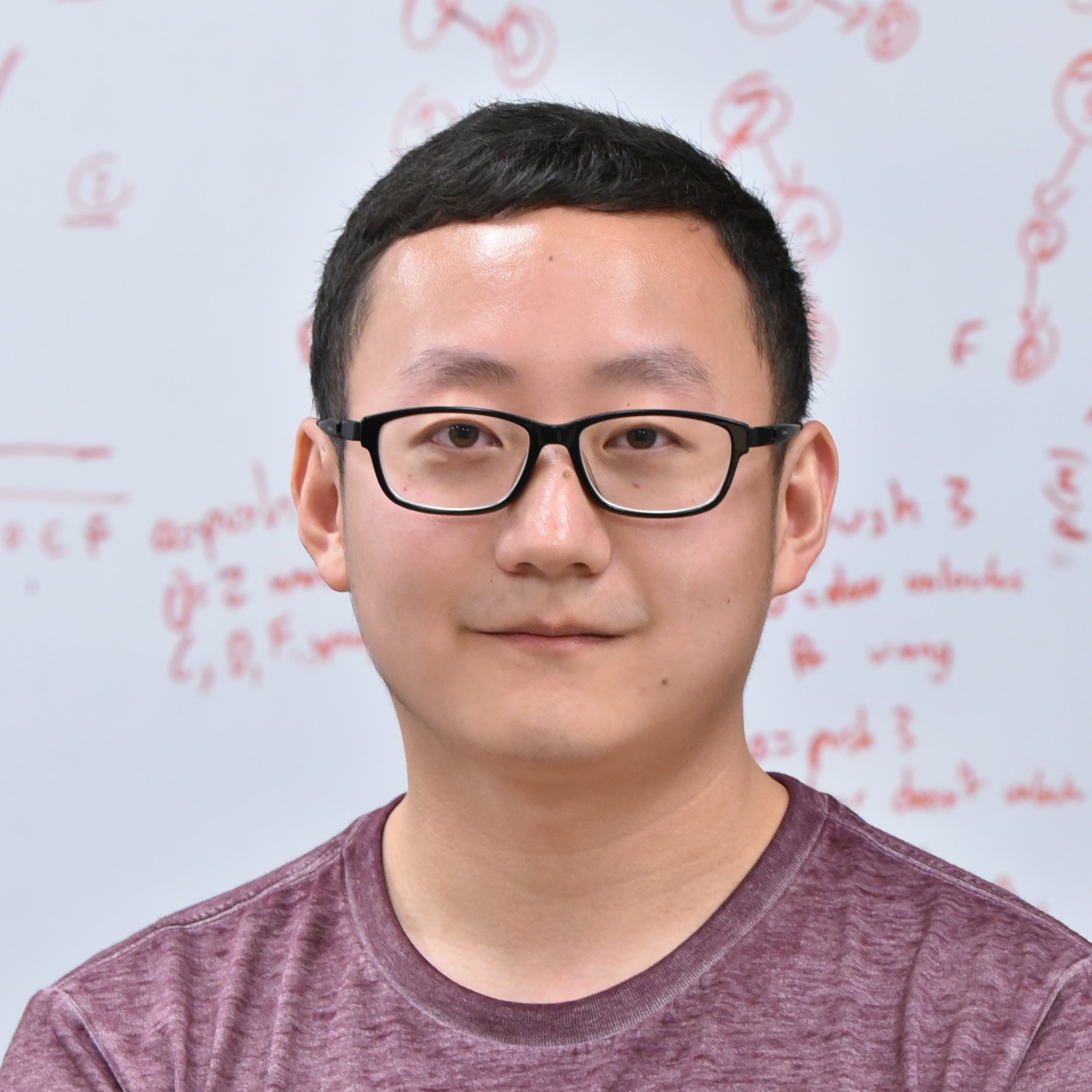
I am the director of the Social Cognitive AI (SCAI) Lab and an Assistant Professor in the Department of Computer Science at Johns Hopkins University. I also hold a courtesy appointment with the Deparment of Cognitive Science. My research goal is to advance human-centered AI by engineering machine social intelligence to build socially intelligent systems that can understand, reason about, and interact with humans in real-world settings. I approach this from an interdisciplinary perspective, connecting machine learning, computer vision, robotics, and social cognition to study machine social intelligence. Before joining JHU, I was a Research Scientist at MIT working with Josh Tenenbaum and Antonio Torralba.
Office: Malone Hall 213   Email: tianmin.shu [at] jhu.edu
07/2026: ThoughtTrace received the best paper award at ICML RLxF Workshop.
06/2026: Invited talk at CVPR 2026 Workshop on Embodied Reasoning in Action.
04/2026: Invited talk at UMass Amherst.
04/2026: Invited talk at UVA.
10/2025: Invited talk at ICCV 2025 Workshop on Artificial Social Intelligence.
09/2025: Invited talk at CoRL 2025 Workshop on Resource-Rational Robot Learning.
08/2025: Invited talk at the Computation and Cognition Conference, Dalhousie University.
08/2025: Invited talk at Google.
07/2025: Invited talk at CogSci 2025 Workshop on Putting it together: Interactions between domains of cognition.
06/2025: Invited talk at CVS.
06/2025: Invited talk at CVPR 2025 Workshop on Humanoid Agents.

My group studies machine social intelligence: building AI agents that can understand, reason about, and interact with humans and other agents in complex, open-ended environments. We are particularly interested in agents that learn from embodied and social experiences, build models of the world and other minds, and cooperate with humans and machines over long horizons.
Online World Modeling for Long-Horizon Planning: Developing agents that construct and update world models for planning in partially observed, dynamic, and long-horizon environments. Related work: 3D-Belief; World-in-World (ICLR 2026 Oral).
Open-Ended Agent Modeling and Multimodal Theory of Mind: Building computational models of agent behavior, enabling AI systems to reason agents' mental states and social relationships from multimodal inputs in open-ended settings. Related work: MindZero (ICML 2026); AutoToM (NeurIPS 2025 Spotlight); MuMA-ToM (AAAI 2025 Oral); MMToM-QA (ACL 2024 Outstanding Paper Award).
Multi-Agent and Human-AI Cooperation: Studying how agents communicate and collaborate effectively with humans and other agents in shared physical and virtual environments. Related work: GOMA (IROS 2024); NOPA (ICRA 2023).
Continual Learning from Embodied and Social Experiences: Enabling agents to continously acquire new knowledge and skills through long-term interaction with humans, other agents, and the physical world. Related work: AgentOdyssey; ThoughtTrace (ICML 2026 RLxF Best Paper Award).
Large-Scale Open-World Simulations: Creating scalable simulation environments for studying embodied and social reasoning, cooperation, and open-ended learning in rich multi-agent worlds. Related work: SimWorld (NeurIPS 2025 Spotlight); SimWorld-Robotics (NeurIPS 2025).